At an industry gathering in January 2025, Golf Estates homeowner Robert Millar asked Modernism Week CEO Lisa Vossler Smith a question that seemed to have gone unasked for two decades: why had the festival never come east to La Quinta Country Club? Her answer wasn't about the architecture's quality. It was about who had ever been willing to unlock a gate. "Because, Robert, nobody's ever volunteered to make it happen," she told him.
That line explains more than it seems to. Palm Springs has spent seventy years turning its midcentury homes into a public identity, with docent tours running through Twin Palms and Vista Las Palmas every February. A few miles east, La Quinta Country Club has been sitting on work by some of the same architects the entire time, unseen by anyone outside its membership. The gap was never talent. It was that no one inside those gates had agreed to let people look.
Millar changed that this year. On February 19, 2026, the club hosted its first Modernism Week Signature Home Tour, a sold-out walk through six private residences spanning 1959 to 2023, one stop among more than 450 events across the festival's eleven days in its 21st year. It was the only stop on the 2026 calendar that required opening a door nobody had opened publicly before.
Someone Already Tried, and Failed
Millar wasn't the first to attempt this. In 2018, Linda Williams, president of the La Quinta Historical Society, tried organizing her own home tour, writing letters to homeowners asking them to take part. Nothing came of it. The difference between her attempt and Millar's wasn't effort. It was standing. Millar was a member asking his neighbors directly, not an outside historian asking on behalf of an institution. In a club built around discretion, that distinction turned out to matter more than any letter could.
Privacy Was the Product, Not an Accident
The club's course opened in 1959 with Bing Crosby and Bob Hope in the inaugural round, and President Dwight D. Eisenhower dedicated the grounds a year later with an 8-iron shot down the fairway. His brother, a member, was long believed to keep a home nearby. Frank Sinatra, Dean Martin, Jackie Gleason, Clint Eastwood, and athletes including Willie Mays and Jack Kramer followed as members over the decades, and the club hosted the Bob Hope Desert Classic, the tournament now known as the American Express.
That guest list explains the gates. A community built to host that level of visibility doesn't advertise its floor plans. The architecture, whatever its merits, was built to disappear behind hedges, and the members who renovated or expanded over the years had no reason to invite scrutiny. The privacy wasn't a side effect of the design. It was what the design was for.
Six Houses, Six Decades
The tour that finally happened covered:
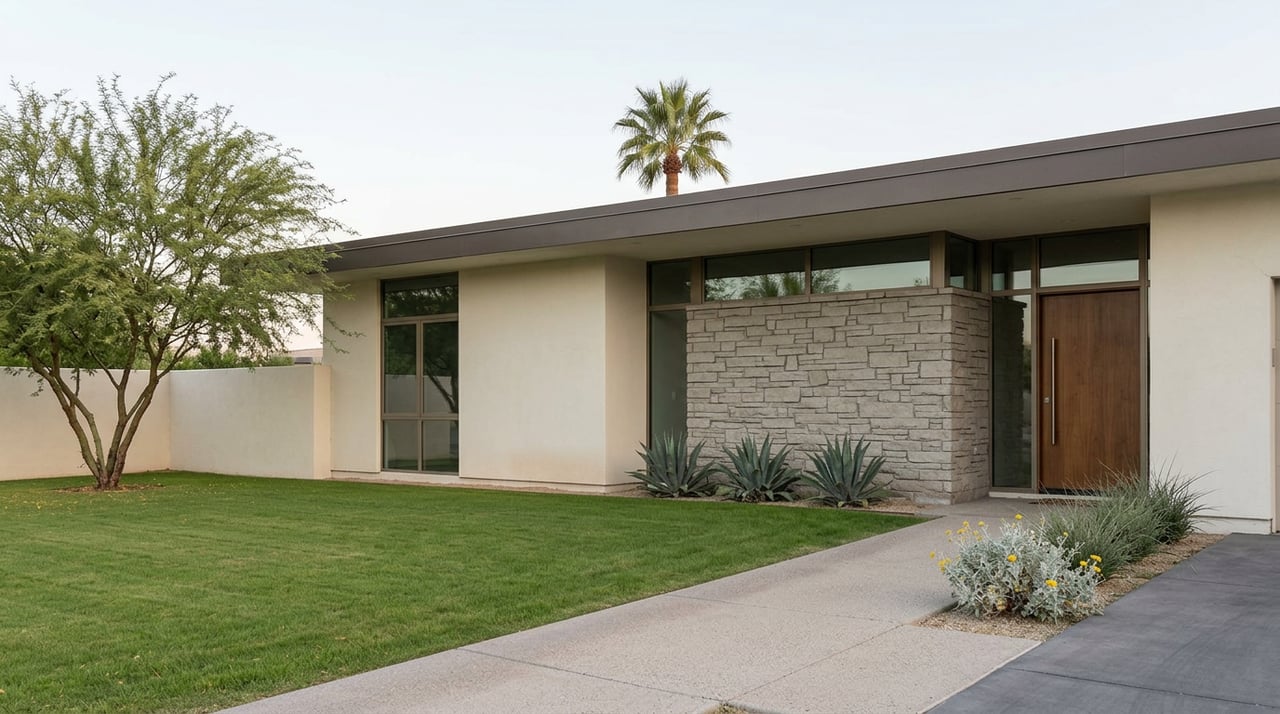
- An early LQCC spec home, built between 1959 and 1962 by Visscher & Associates to help sell the original subdivision, with long horizontal rooflines and stacked-stone walls typical of the era.
- A 1960 residence by architect George Rocher, with a courtyard pool, vertical brick columns, and a connected casita now used as a home office.
- The Nanni House, finished in 1962 with no documented architect. According to the tour's own brochure, no other home in the club shares its design.
- The Sunrise House, built in the late 1960s by Robert Ricciardi, updated by Lance O'Donnell in 2010, and renovated again in 2024 by designer Mario Guariso, who is married to Millar.
- A 1991 estate by Laszlo Sandor, owned by filmmaker Matt Tyrnauer. He has described its mix of high modernism, brutalism, and post-modern flourishes as reading like a confident nod to Hollywood-era desert glamour, built to frame the mountain view.
- The Shepanek House, completed in 2023, a contemporary design by Lance O'Donnell built to read like an authentic 1950s home, down to its horizontal rooflines and glass-walled indoor-outdoor flow.
Six houses, six decades, and every one of them sat a few streets from a golf course most of the valley has driven past without knowing what was behind the hedges.
The House Still Not on the Tour
Even this reveal came with limits. The most talked-about home in Golf Estates, a 1960 design by A. Quincy Jones and Frederick Emmons built for film director Frank Capra, was not part of the tour. Its absence says almost as much as the six houses that were included. Opening the gates for one afternoon didn't mean opening every door. The club let the public see enough to change the conversation about its architectural history, and not a square foot more.
Knowing Which Part of the Club You're Standing In
"La Quinta Country Club" is really thirteen separate tracts bounded by Eisenhower Drive, Washington Street, and Avenue 50, containing roughly 475 houses in total. Golf Estates, the tract Millar himself calls home, is the largest and the one most closely tied to the modernist reputation the tour just uncovered. Country Club Estates is the original 1958 subdivision that started it all. Montero is a 1970s ranch-style enclave with a different look entirely. If your home sits in Montero, the midcentury story the tour told isn't really about your street. If it sits in Golf Estates, you may be living inside that story without ever having heard it.
What You've Been Driving Past
The clubhouse itself has already been rebuilt once, reopening in 2009 in its original Santa Barbara-Mediterranean style after earthquake damage in 2005, with interior updates completed again in 2023 according to the club's own site. That kind of visible reinvestment is easy to notice from the street. The quieter history, the one behind individual gates, took a homeowner willing to ask his neighbors directly, and a festival willing to wait almost seventy years for someone to do it.
If you live in La Quinta Country Club, the walk or golf cart ride you take most mornings passes homes that trace a real architectural lineage, one that predates the version of desert modernism most people associate with Palm Springs alone. Most of it is still private. That's unlikely to change soon, and after nearly seventy years of staying that way, there's no reason to expect otherwise.
I spend a fair amount of my own time noticing which streets in this valley are hiding the best stories, and Golf Estates just moved to the top of that list. If a specific home's history has you curious, or you just want to talk architecture over coffee, reach out to Kathleen Galigher. Let's Connect.